Monday, 14 March 2011
Tuesday, 8 March 2011
Tuesday, 15 February 2011
Cockle Creek and Recherche Bay
Recherche bay is the site of the first scientific experiments on Australian soil. The French explorer Antoine Raymond Joseph de Bruni d’Entrecasteaux (what a groovy name) landed in 1792 and made a garden and observatory and mapped and named parts of Southern Tasmania, which has resulted in Tasmania having some beautiful French names mixed up with Indigenous and English names. Bruni d’Entrecasteaux’s ships included the Recherche and the Esperance.
One of the goals of Bruni d’Entrecasteaux’s voyage was to try and find the explorer Jean-Francois de Galaup, comte de La Perouse who was last seen in Botany Bay in 1788 heading off towards New Caledonia.
Recherche Bay
"It would be vain of me to attempt to describe my feelings when I beheld this lovely harbour lying at the world's end, separated as it were from the rest of the universe.”
- Antoine Raymond Joseph de Bruni d’Entrecasteaux
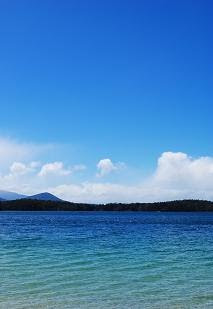
Beach at Cockle Creek
Cockle Creek is the southern most point that is assessable in Australia. The beach is beautiful, and when I was there the sky and water were beautiful shades of blue.
Cockle Creek is also host to a sad period in Australia’s history being a centre for whaling in the 1830s. A bronze statue of a Southern Right Whale Cub mourns for all the whales killed in the area. The whalers used to kill the cubs and when the adults heard their cries would run in to see what the matter was and then be killed as well.
Whale statue at Cockle Creek - sculptured by Steven Walker
“The next stop is Antarctica. And it’s not that far away. Standing here, you are closer to Antarctica than you are to Cairns.”
- Australian Government – Department of Resources Energy and Tourism
The southernmost point that you can buy food is Ida Bay. Where naturally I had a Devonshire Tea.
Wednesday, 9 February 2011
Saturday, 29 January 2011
Signs, Traffic and Things
Some people told me that the End zones meant to go back to the penultimate speed limit, some suggested to do either 100 or 110kh/hr. And in the south there was a sign that suggested 90km/hr.
And there were difficult winding roads, and I am a good driver and know what I’m talking about, where I was doing 90 and people would overtake me doing over 110. I guess it doesn’t really matter as long as you survive and don’t get a ticket – but I would have appreciated clearer signs.
I was driving through Barrington for no particular reason… ok, I was looking for a coffee… I was flying past and saw a very weird sign, it was one of those yellow diamond signs that tell you to look out for particular animals crossing the road. But this wasn’t warning me about kangaroos or echidnas. Flying past it looked like a dragon. ‘Hmmm… That’s odd,’ I thought ‘I’m pretty sure that there are no dragons in Tasmania.’
There was only one thing to do. I dropped a U-ey, parked the car and hopped out of the car for a closer inspection.
Which made me wonder how often do platypi cross roads? And why do platypi cross roads? Are they in the wrong joke or something?
To answer these questions I travelled to Platypus House at Beauty Point and they were quite surprised to hear of the road sign. But they couldn’t help with any existential road crossing monotreme questions. And I left thinking it was probably just a local who wanted a good laugh.
There are a number of interesting place names in Tasmania. Like Nook as pictured above, but I like this sign that has two interesting places.
I can image how the conversation went:
A: Does this place look familiar to you?
B: What do you mean?
A: It looks a bit like Kent.
B: Kent? Are you sure? Perhaps West Kent?
A: Yes, West Kent.
B: Well... West Kent-ish.
You can imagine my disappointment when I discovered that Kentish was named after a person. Perhaps his nose looked like one of the mountains in Kent…
And the other name is so awesome that I think that nothing else can be said.
Thursday, 27 January 2011
Cradle Mountain
I like the warning on the Tasmanian Parks & Wildlife Service website: “Visitors should bear in mind, however, that the wild weather of the Tasmanian highlands often shrouds the mountain in cloud”. I drove from Launceston and when I set out the entire sky was covered with cloud. and as I approached the national park, the sky slowly cleared.
This photo was taken from the top of a nice rock (which I’ve forgotten it’s name) and is a very nice place to sit and soak in the atmosphere.
Nikon D3000 – Zoom: 200mm
There is a Tourist Information Centre a couple of k’s before Cradle Mountain, where you can buy your pass to get into the national park, touristy stuff and a map, and a bus ticket. The shuttle bus takes people from the information centre to Lake Dove, and runs every fifteen minutes or so. It is much cheaper than buying a ticket for your car, and there is not much parking at the lake.
There seems to be two types of people who go to Cradle Mountain. Tourists who just want to cross things off their list and don’t want to walk or talk, and serious walkers who are pleasant to talk to.
There is not much to say about Cradle Mountain. It is a beautiful place. And I would like to visit again.
There are a number of walks that can be done. I walked clockwise around Lake Dove, then up the steep section past Lake Wilks to Little Horn and then back via Marions Lookout. This walk took me about four hours, but includes a good half an hour for lunch and a lot of time taking photos.
Tuesday, 25 January 2011
Sheffield
2009 Winner - Mark Spijkerbosch 'Fire and Life'
Thursday, 20 January 2011
Senses Garden
Tuesday, 18 January 2011
The Boat There and Back Again
Things no one tells you: waiting to drive on board takes a very long time. Bring a book. If you have passengers I would recommend that they go on board without you and taking everything to the cabin for you. You and the car will be waiting for what seems like forever. Oh, and getting there first doesn’t mean your car will go on first – they sort the cars by size – which due to balance makes sense.
When I arrived on board I ran to my seat, put my stuff down, applied sunscreen, got my camera and ran to the outside stern area to get a good seat. And when the ship started I enjoyed watching Melbourne disappear into the distance, and then we were treated to a magnificent sunset.
I took so many photos of the sunset - I can not decide which ones are the best.
Warning: In summer if you watch the sunset the kitchens might be closed by the time you get to the restaurant.
The food in the Leatherwood Restaurant was beautiful, small but nice. I did have to have all three courses to feel full. The other restaurant was a buffet and everything looked very oily and there was not much for vegetarians.
Level seven of the ship has two restaurants, a couple of bars and plenty of chairs to sit down and enjoy the ride.
I had trouble getting to sleep – someone nearby was reading and their light kept me awake. Going to Tassie I only get two hours sleep. I was sort of happy that I woke up really early. I found a comfortable position at the bow of the ship and watched the sky slowly turn blue and the mountains around Devonport appear with the entire deck to myself.
Going back to Melbourne on the ship I was quite exhausted so I sat in my recliner and watched Devonport disappear as I did Killer Sudokus. The recliner room was half empty and they seemed to have empty chairs between everyone which made it a lot more comfortable. I was glad that I booked my tickets very early as I was able to get a front row seat in both directions.
I was able to sleep for four hours going back, and woke up as we gained mobile phone services through Port Phillip Heads. It was beautiful to watch the lights of Sorrento, Blairgowrie, Mt Martha glide past, and record their interesting signals of the channel markers.
Friday, 14 January 2011
Saturday, 8 January 2011
Birds and Animals
Seahorses - 'The World of the Seahorse' at Beauty Point
Seagull taken whilst on the Spirit of Tasmania 1 in Port Phillip Bay
Pied Oyster Eater - Wineglass Bay
I know this isn't a real bird, but I liked the photo for some odd reason.
Lizard - Dove Lake & Cradle Mountain
Ducks - Tasmanian Arboretum
Little Red Thing - Port Arthur
More Birds - Tasmanian Arboretum
Cormorant - Dove Lake
Chickens - Middle of nowhere